Spectrum of the Mind: Exploring Cognitive Profiles and Diversity in Genius
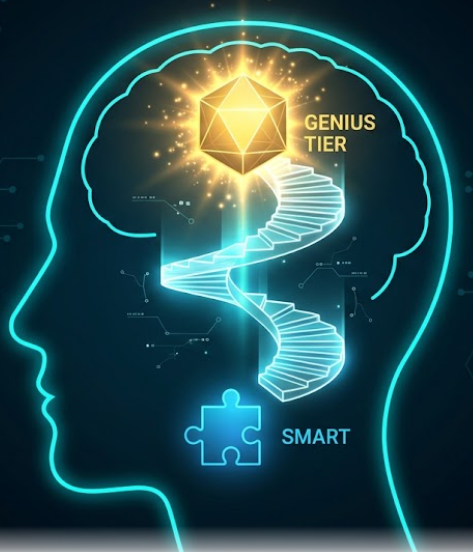
Genius is rarely a uniform or monolithic trait. Historically, standardized psychometric tests categorized intelligence primarily through mathematical speed and linguistic syntax. However, modern cognitive neuroscience demonstrates that human intellectual excellence manifests across a wide spectrum of specialized mental architectures. Expecting every extraordinary mind to excel at the same standardized tasks overlooks the rich diversity of human cognition. Understanding how different mental profiles receive, process, and synthesize data is essential for accurate cognitive self-assessment and targeted intellectual growth.
1. The Logico-Mathematical & Algorithmic Mind
This cognitive profile represents the classic analytical archetype. Individuals with dominant logico-mathematical processing excel at symbolic reasoning, quantitative abstraction, and computational logic. Their brains naturally organize unstructured data into clear, hierarchical systems and step-by-step algorithms.
In real-world applications, algorithmic thinkers are uniquely equipped to identify structural flaws within complex codebases, design optimized data pipelines, evaluate cryptographic structures, and formulate mathematically sound strategies. Their mental strength lies in objective detachment and precise deductive accuracy.
2. The Visual-Spatial Architect
Visual-spatial intelligence involves the ability to manipulate complex three-dimensional visual forms within the mind's eye. While an algorithmic thinker processes information sequentially (like code), a visual-spatial thinker evaluates concepts holistically, seeing entire structural landscapes simultaneously.
Engineers, system architects, industrial designers, and visual puzzle creators leverage this dimensional capability to simulate physical rotations, stress tests, and geometric relationships mentally before committing a single line to blueprints or software interfaces.
3. The Strategic & Game-Theoretic Genius
Strategic genius revolves around dynamic decision-making under conditions of incomplete information and active competition. Unlike static logical evaluation, game-theoretic thinking factors in external human variables, strategic counter-moves, risk probabilities, and shifting environmental parameters.
- Multi-Step Anticipation: Calculating four or five moves ahead in complex, competitive systems.
- Payload Risk Management: Balancing potential reward against existential downside risks in volatile scenarios.
- Adaptive Counter-Play: Rapidly re-evaluating strategy when unexpected external variables disrupt the baseline model.
4. Comparative Matrix of Cognitive Architectures
To better understand these distinct expressions of intellect, we can compare their underlying neurological drivers and practical domain applications:
| Cognitive Profile | Primary Neurological Dominance | Core Intellectual Strength | Optimal Real-World Application |
|---|---|---|---|
| Logico-Mathematical | Left Prefrontal & Parietal Cortex | Symbolic deduction & system optimization | Backend engineering, cryptography, analytics |
| Visual-Spatial | Parieto-Occipital Networks | Multi-dimensional mental modeling | Architecture, UI/3D design, simulation engineering |
| Game-Theoretic | Orbitofrontal & Anterior Cingulate | Dynamic risk modeling & multi-step foresight | Strategic management, competitive gaming, finance |
| Intuitive Synthesizer | Default Mode & Global Salience Networks | Cross-domain association & novel ideation | Product innovation, polymathic research, architecture |
5. The Intuitive Polymath & Cross-Domain Synthesizer
Perhaps the rarest form of cognitive mastery is the cross-domain synthesizer—often referred to as a polymath. These individuals possess a broad, highly flexible mental web that connects seemingly unrelated disciplines. A polymath might adapt a biological evolutionary model to solve a software distribution issue or apply musical rhythm patterns to optimize data compression algorithms.
Their strength comes from their ability to translate mental models across domain boundaries, creating novel concepts that domain-isolated specialists often overlook.
6. Identifying and Optimizing Your Individual Cognitive Footprint
No single cognitive profile is superior to another; high-performing organizations and development teams require a combination of all four types to build resilient systems. By engaging with diverse logic puzzles, pattern-recognition exercises, and situational assessments, you can map your personal strengths, identify cognitive blind spots, and purposefully train underutilized neural networks.