Demystifying IQ in India: Understanding Cognitive Metrics, Educational Dynamics, and National Potential
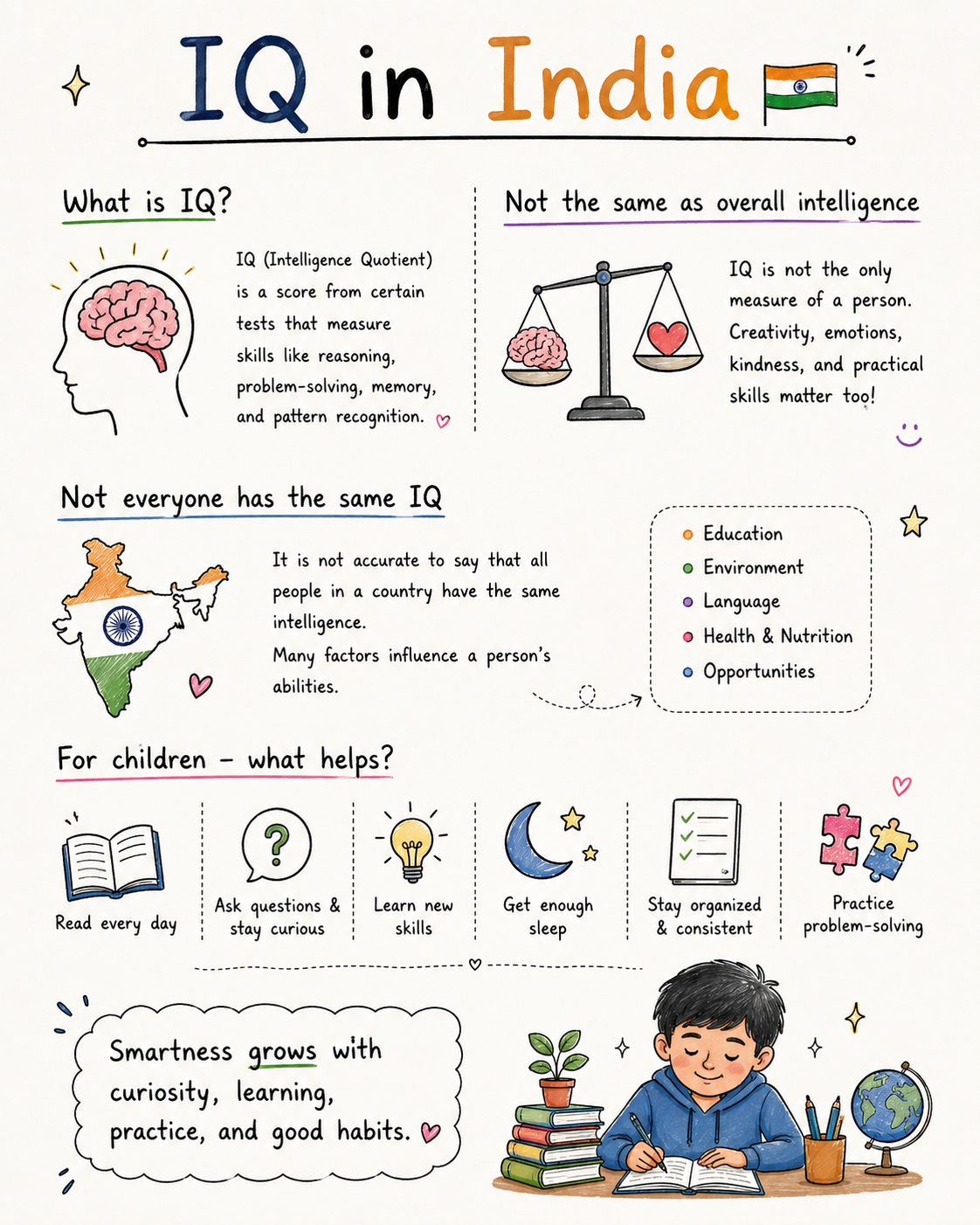
The conversation around Intelligence Quotient (IQ) scores in India is frequently subject to widespread misconceptions, methodological errors, and outdated assumptions. In many international datasets and viral online discussions, cross-country IQ comparisons present numbers that fail to account for socio-economic disparities, linguistic diversity, and regional educational infrastructure. To understand cognitive testing in a country as vast and multi-faceted as India, one must examine how intelligence is defined, measured, and cultivated beyond simple standardized formulas.
1. The Evolution of Psychometric Assessment in India
Historically, standardized IQ testing was developed in early 20th-century Europe and North America. Tests like the Stanford-Binet and early Wechsler scales were heavily reliant on specific cultural references, English language fluency, and Western social contexts. When applied blindly to non-Western populations, these tools consistently produced biased results because they measured cultural familiarity rather than raw fluid intelligence.
In response, Indian psychologists and psychometricians developed adapted framework systems designed to minimize cultural and linguistic bias. Prominent examples include Raven’s Standard Progressive Matrices (SPM) and the Malin’s Intelligence Scale for Indian Children (MISIC). These non-verbal tests focus on abstract visual pattern matching, spatial reasoning, and matrix logic—eliminating the requirement for formal English literacy and allowing researchers to evaluate an individual's innate logic independent of their schooling background.
2. Socio-Economic Factors and the Environmental Flynn Effect
Cognitive research across developmental economics consistently validates the "Flynn Effect"—the observed phenomenon where aggregate national IQ scores steadily rise over successive generations as living standards improve. An individual's intelligence is not a rigid biological capacity set in stone; it is significantly influenced by early childhood nutrition, healthcare access, environmental stability, and quality of instruction.
- Nutritional Access and Brain Development: Micronutrient deficiencies, such as iodine, iron, and essential fatty acids during early childhood, directly impact neurodevelopment and synaptic growth. As public health initiatives improve baseline nutrition across urban and rural sectors, average cognitive metrics demonstrate a measurable upward trajectory.
- The Shift from Rote Learning to Critical Thinking: India's traditional primary education system heavily prioritized memorization and repetition. Modern educational reforms and adaptive learning technologies actively shift the focus toward problem-solving, situational reasoning, and practical logic. Exercising fluid intelligence during formative years alters neural pathways, strengthening analytical performance.
- Digital Literacy and Cognitive Exposure: The rapid spread of mobile internet across tier-2 and tier-3 cities has democratized access to logic puzzles, strategy games, and interactive educational content. Continuous exposure to complex visual interfaces and digital problem-solving environments builds cognitive familiarity, raising baseline scores on standard psychometric matrices.
3. Measuring Fluid vs. Crystallized Intelligence
When analyzing IQ metrics within the Indian population, it is essential to separate fluid intelligence (Gf) from crystallized intelligence (Gc).
Crystallized Intelligence (Gc) represents accumulated knowledge, vocabulary, and learned skills. It is heavily dependent on formal schooling and socioeconomic environment. An individual who has not had access to advanced secondary education may score lower on tests requiring vocabulary or general knowledge retrieval, despite possessing exceptional natural mental sharpness.
Fluid Intelligence (Gf) refers to the fundamental ability to think logically, spot patterns, analyze abstract relationships, and solve unfamiliar problems without relying on prior instruction. Tests designed around situational logic, algorithmic deduction, and pattern matrix completion—such as the challenges on Genius United—measure fluid intelligence directly. Across various socio-economic studies in India, fluid intelligence benchmarks routinely show high potential across all demographics when tested through culture-fair mediums.
4. The Path Forward: Gamified Cognitive Training
To unlock national potential, modern educational technology must move past rigid, one-size-fits-all testing metrics. Gamified cognitive assessments offer a promising alternative by turning logic evaluation into an interactive experience. By presenting participants with situational puzzles, deception detection challenges, and strategic simulations, gamified tools transform testing from a high-stress academic exam into an engaging mental exercise.
Cognitive capacity in India is expanding rapidly. As culture-fair assessments become the standard and interactive logic platforms replace archaic memorization routines, the understanding of intelligence in India is evolving from a static number into a dynamic, trainable human capability.